Packing materials determine how well items survive a move. Material choice affects impact resistance, weight distribution, and how items behave inside boxes and during transport. Professional movers use commercial-grade materials such as double-wall boxes, higher burst-strength cartons, and thicker protective wraps that perform differently from retail-grade supplies. Selection depends on item type, fragility, weight, and handling conditions from packing through delivery. Global 360 Moving matches material selection to the risk level of each item and adjusts based on whether the move is local or long-distance.
Why Packing Materials Matter More Than Most People Expect
Packing materials control how items absorb force, how they interact with surrounding items, and how stable the load remains during handling and transit.
Incorrect material choices increase risk. Examples include using single-wall boxes for heavy items, leaving empty space inside boxes, or failing to add internal padding. These conditions allow shifting, compression, and force transfer to vulnerable areas even when handling appears careful.
Damage Prevention During Transport
Packing materials protect items from two types of damage, handling damage and transit damage. During lifting, carrying, and loading, handling damage occurs. In contrast, vibration, braking, and movement inside the truck create transit damage.
Different materials address these risks in specific ways. Bubble wrap cushions impact during handling, foam stabilizes items against repeated vibration, and rigid containers prevent deformation when stacked or compressed.
Load Stability and Organization
Packing materials determine how items sit within boxes and how those boxes stack inside the truck. Stable packing prevents shifting and reduces internal collisions.
Placement also affects overall load stability. Heavier boxes sit on the base layer, while lighter ones stay above. Across the truck floor, weight must remain evenly distributed to avoid pressure points and reduce the chance of stack collapse during transport.
Types of Moving Boxes and When They Are Used
Moving boxes vary in size, strength, and construction. Professional movers match box type to item weight, size, and fragility to prevent overloading and structural failure.
Box strength depends on construction. Single-wall boxes work for lighter items, while double-wall boxes handle heavier loads and stacking pressure.
Standard Boxes vs Specialty Boxes
Standard boxes handle general household items such as clothing, books, and non-fragile goods. They come in multiple sizes to match weight and volume.
Specialty boxes reduce risk through structural design. Wardrobe boxes maintain hanging clothing position. Dish packs include dividers that separate fragile items. Reinforced cartons support heavier or irregular loads that would damage standard boxes.
Even with added padding, standard boxes cannot replace specialty boxes for fragile items because they lack internal structure and reinforcement.
Weight Limits and Item Matching
Each box has a practical weight range based on its size and construction. Small boxes carry heavier items to keep loads manageable, while larger boxes hold lighter items to avoid excessive weight.
Weight limits depend on box strength, handling conditions, and stacking pressure. Exceeding those limits increases the risk of tearing, collapsing, or unsafe lifting.
Protective Wrapping Materials and Their Purpose
Protective wrapping materials serve two roles, cushioning and surface protection. Cushioning absorbs impact and vibration, while surface protection prevents scratches and abrasion. Material selection depends on how the item reacts to pressure, movement, and contact with other objects.
Bubble Wrap, Foam, and Moving Blankets
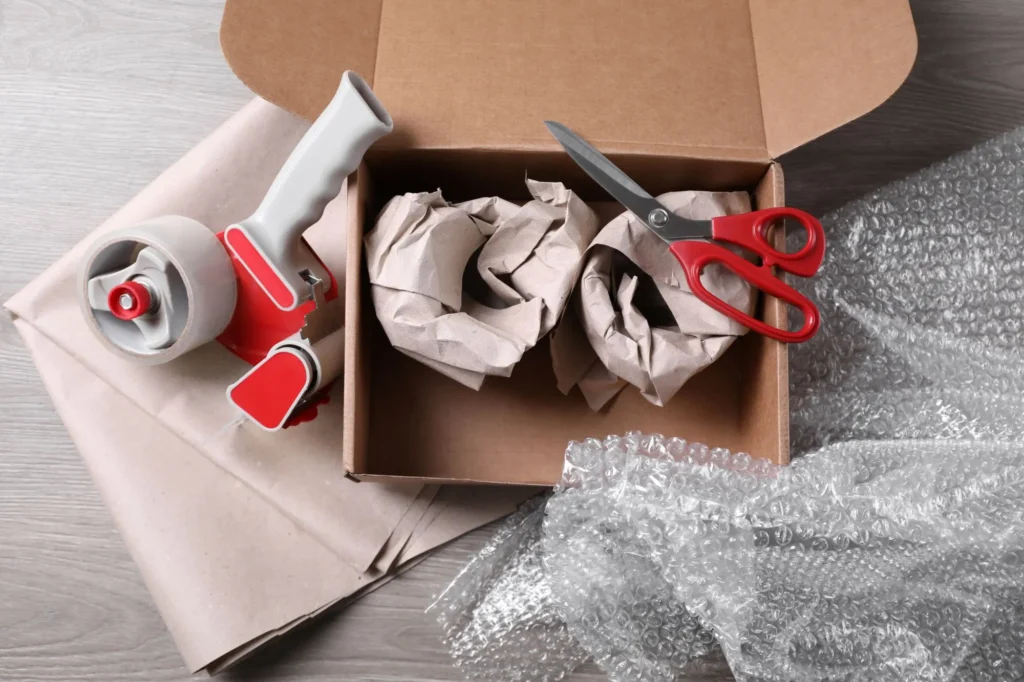
Bubble wrap cushions impact but does not prevent compression under heavy load. Foam provides consistent support and helps stabilize items against vibration. Moving blankets protect large surfaces from scratches and friction but do not secure internal components. Each material addresses a specific risk, so movers often combine them to achieve both cushioning and protection.
Protecting Fragile and High-Value Items
Fragile and high-value items require layered protection that scales with risk. Greater fragility or longer transport distances increase the level of protection required.
To achieve this, movers combine materials to create both cushioning and structural support. A typical setup may include foam wrapping, added bubble wrap for impact absorption, and placement inside a reinforced box with padding that prevents movement.
Crating for High-Value, Fragile, or Irregular Items
Crating provides a rigid structure that isolates items from external force and prevents movement. This method delivers a higher level of protection than standard boxes or wrapping. Movers use crating when items require full support or isolation that other materials cannot provide.
When Crating Is Necessary
Crating becomes necessary when fragility, shape, or weight prevents safe packing inside standard boxes. Value alone does not determine the need for crating. Instead, the decision depends on how easily the item can be damaged.
Items with high replacement cost, structural sensitivity, or irregular dimensions often require crating when standard methods cannot stabilize or protect them.
Custom Crating for Specialty Items
Custom crates match the exact dimensions and support requirements of the item. Internal bracing, blocking, and anchoring eliminate movement inside the crate.
Crates can be partial or fully enclosed. Partial designs support structure while allowing access, while full enclosures provide complete protection from impact and pressure.
Packing Materials for Electronics, Furniture, and Appliances
Different categories of items require different packing strategies. Electronics require internal stabilization, furniture requires surface protection, and appliances require both external and internal control. Material selection must match the specific vulnerability of each category.
Surface Protection and Internal Protection
Surface protection prevents visible damage such as scratches and dents. Movers use blankets, wraps, and padding to cover exposed areas.
Internal protection stabilizes components that can shift or break during movement. Electronics and appliances require internal control to prevent damage to circuits, motors, or connections.
Preventing Movement Inside Boxes
Movement inside a box causes repeated impact during transport. Even small gaps allow items to shift and collide. To eliminate that movement, packing paper, foam inserts, or air cushions fill empty space so items remain stable and do not transfer force to each other.
How Professional Packing Reduces Damage Risk
Professional packing reduces damage risk by combining correct material selection with a structured process. This approach ensures consistent protection from packing through delivery.
Common failure points include overloading, poor cushioning, and unstable stacking, which this process is designed to prevent.
Proper Material Selection
Movers select materials based on fragility, weight, handling frequency, and exposure to stacking pressure. A single material does not apply across all items. Instead, each item receives protection that matches its specific risk profile.
Structured Packing Process
Professional packing follows a defined workflow. Movers sort items by type, wrap them with appropriate materials, place them in matched containers, fill voids, label contents, and stage boxes for loading. This sequence maintains consistency and reduces handling errors throughout the move.
Choosing the Right Packing Approach for Your Move
The right packing approach depends on budget, item value, time constraints, and move distance. Not every move requires the same level of protection. Customers decide whether to pack everything, pack selected items, or rely fully on professional packing services.
Full Packing vs Partial Packing
Full packing covers all items and provides consistent protection across the entire move. Partial packing focuses on high-risk items while leaving standard items to the customer. High-risk categories for partial packing include glass, electronics, antiques, and fragile or irregular items.
High-Risk Items That Require Professional Handling
High-risk items include fragile objects, heavy items with uneven weight distribution, irregular shapes, and items with sensitive internal components.
Because of these factors, they carry higher failure risk under normal transport conditions. Professional movers apply specialized materials and methods to reduce that risk during the move.